| M T M E L L E R A Y M E D I A L A B | |||
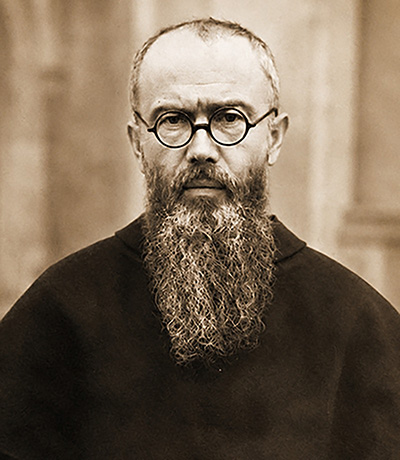
| Saint Maximilian Kolbe | |||
| 1894–1941 · Patron Saint of Journalists · Feast Day 14 August | |||
|
|||
| A Publisher First | |||
|
Kolbe was ordained a Franciscan friar in Rome
in 1918 and returned to a newly independent Poland determined to use the tools
of mass media for evangelization. In 1927 he founded Niepokalanów
— "City of the Immaculate" — outside Warsaw, built around a
printing press rather than a chapel. Within a decade the friary was producing Rycerz Niepokalanej ("Knight of the Immaculata"), a monthly magazine that reached a circulation in the millions, along with a daily newspaper, making Niepokalanów one of the largest publishing operations in prewar Europe. Kolbe ran it the way an editor runs a newsroom: production schedules, distribution networks, recruitment of writers and typesetters, constant experimentation with reach and format. |
|||
| Radio Niepokalanów — SP3RN | |||
|
Print wasn't the ceiling. On 9 September 1938 the
friary put an amateur shortwave station on the air under the call sign SP3RN,
built and operated by the friars themselves to carry Kolbe's broadcasts beyond
the printed page and into homes the magazine couldn't reach. It was, in effect, a monastery running its own wireless newsroom — a detail that tends to surprise people who only know Kolbe from the end of his story. |
|||
| Auschwitz, 1941 | |||
|
The Gestapo shut down Niepokalanów in
1941 and sent Kolbe to Auschwitz. That July, after a prisoner escaped from his
block, the camp selected ten men to die by starvation in reprisal. One of them, Franciszek Gajowniczek, cried out for his wife and children. Kolbe stepped forward and asked to take his place. The guards agreed. Kolbe was the last of the ten to die, on 14 August 1941, after two weeks in the starvation bunker — killed, in the end, by lethal injection when he had not yet succumbed. Gajowniczek survived the war and lived to attend Kolbe's canonization. |
|||
| Patron of Journalists | |||
| Pope John Paul II canonized Kolbe in 1982, declaring him a martyr of charity. He is now invoked as patron of journalists and the press, of amateur radio operators, of families, of prisoners, and of the pro-life movement — a patronage list that reads like a biography of the man himself: what he built with a printing press and a radio transmitter, and what he did with the last months of his life. | |||
| Mt Melleray Media Lab · Mount Melleray Abbey, Cappoquin · medialab-mma.com |